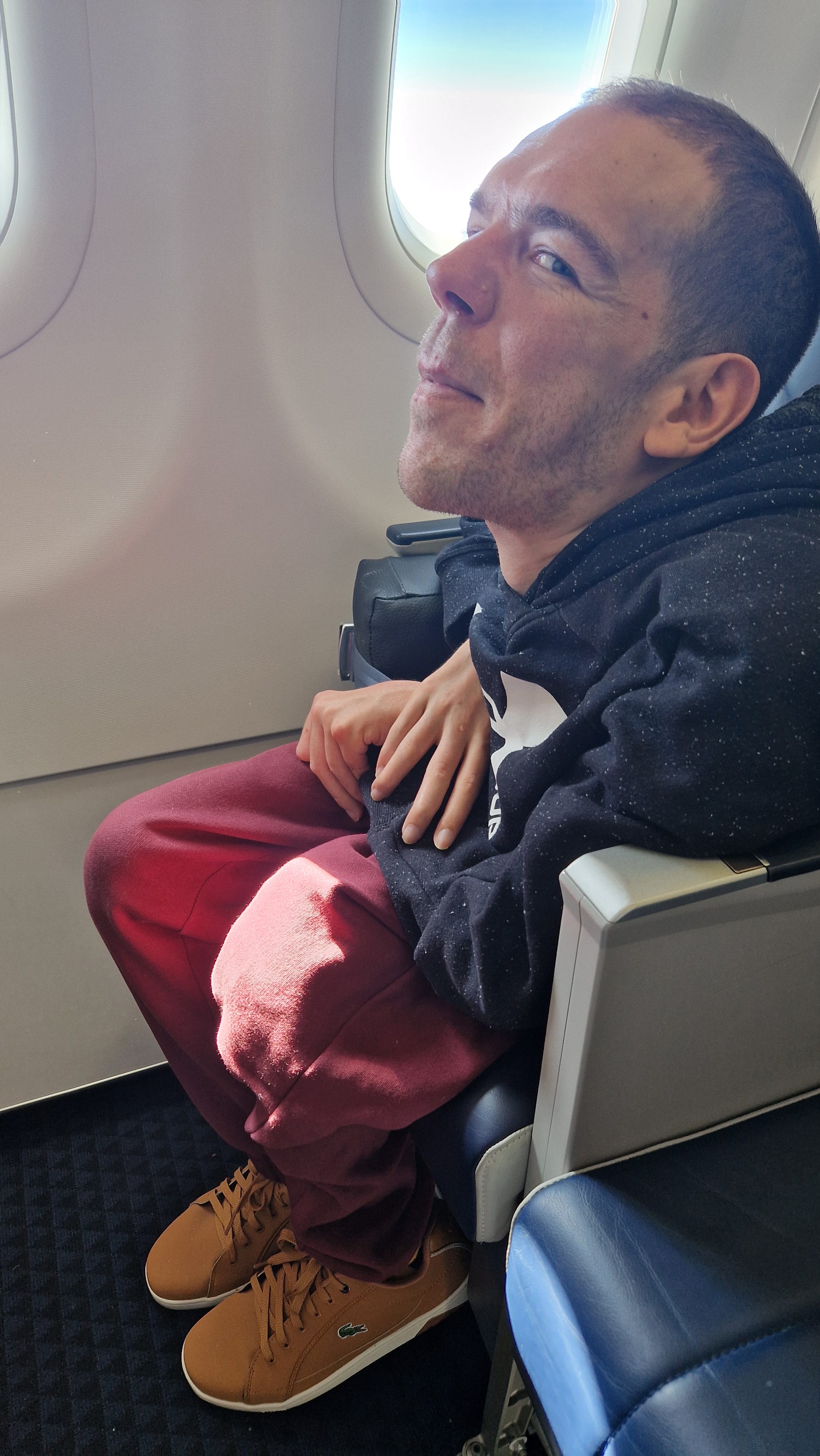
Boarding pass? Check. Passport? Check. Proof I'm not a bomb? Check.
A workshop on accessible air travel by the European Commission and IATA left me hopeful, but also reminded me that disabled travellers are still expected to do everyone else's job.

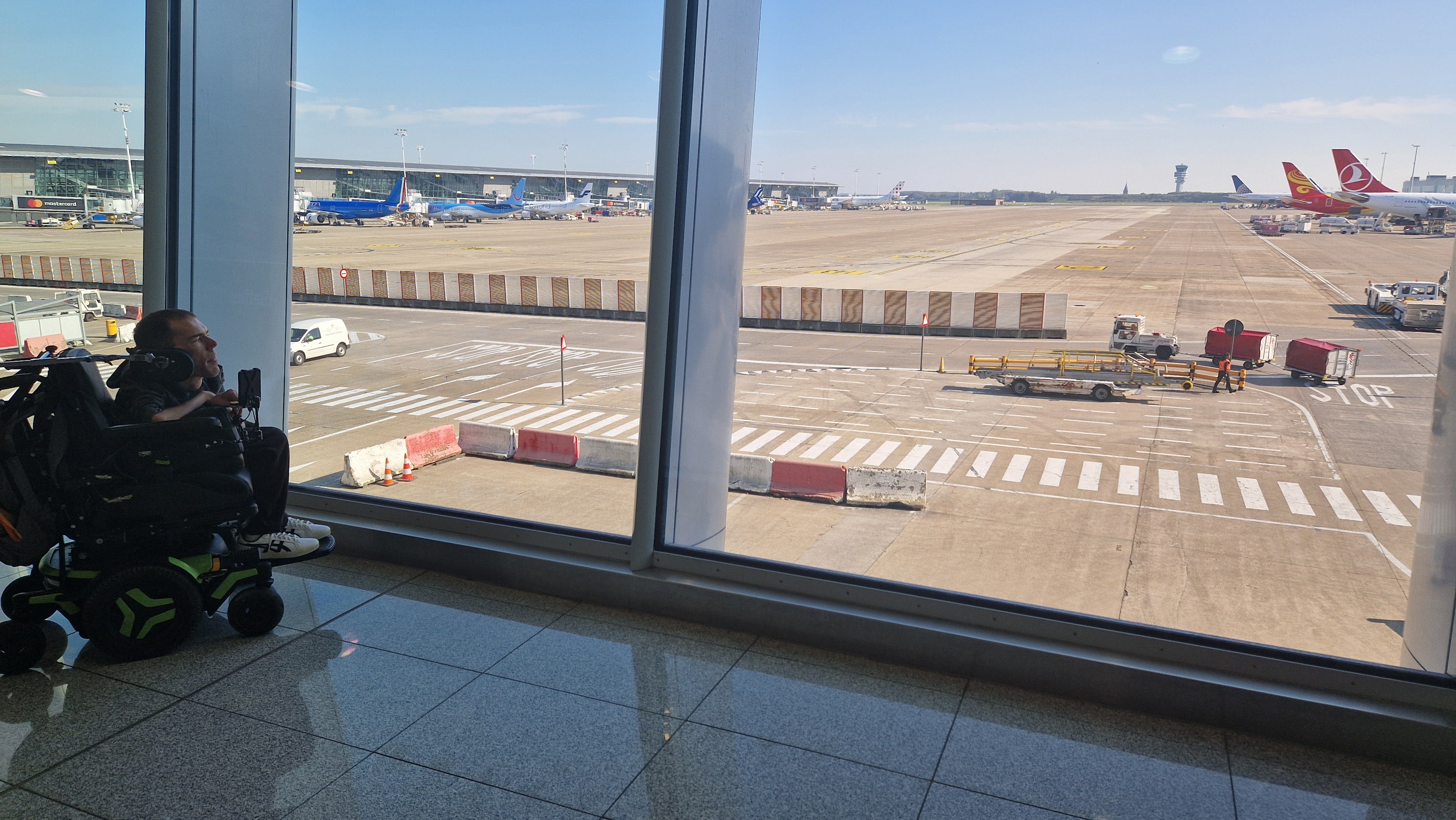
Disclaimer: This is the experience of an electric wheelchair user with very limited mobility. It doesn’t necessarily reflect the experience of other disabled people.
Some days ago I had the opportunity to participate, representing the European Network on Independent Living (ENIL) and wearing my travel blogger hat as well, in a workshop organised by the European Commission together with the International Air Transport Association (IATA) on the transport of mobility equipment in air travel. After all, accessible travel is part of Independent Living.
The workshop brought together almost everyone interested and involved in this issue: disabled travellers, airlines, airport people, wheelchair manufacturer, regulators and disability organisations. These gatherings are really needed because each stakeholder usually sees only one part of the picture. It was valuable for everyone to hear the different perspectives, and I left with the feeling that there is a willingness to move towards more inclusive air travel.
But…
During the discussions, I had the feeling that the responsibility for making air travel possible for disabled people is still often shifted onto disabled travellers ourselves. The message seemed to be that if we want to travel independently, we need to become experts. We need to understand battery regulations, know the technical specifications of our wheelchairs and of the aircrafts we are flying, contact airlines days before travelling and be prepared to explain everything again at check-in or even at the gate. A kind of constant negotiation for our right to fly.
Disabled travellers are often expected to become not only passengers, but also mechanics, chemist, physicists and to some extent aviation specialists before they are even allowed to board. Non-disabled passengers are never expected to do any of this. They simply book a ticket and fly. But we have to. And for me this is discrimination.
I know this because I experience it myself. Apart from my work, I am also a disabled travel blogger (the first in Greece), and I use an electric wheelchair and travel frequently for both work and leisure. I travel more than once a month, and over the years I have become very familiar with the regulations because I had no other choice.
Not long ago I was initially refused from a flight, and spent two days making phone calls, exchanging emails with different departments and people, explaining that my wheelchair was perfectly safe to transport. I even provided all the necessary documentation from my wheelchair manufacturer confirming that it complies with IATA regulations. In other words, I had to spend two days proving that I was not a moving bomb. In the end, I was allowed to fly, not because anything had changed, but because I know my rights and am experienced enough to convince the airline that I was right. They just didn’t know their job…
But this is not the average passenger’s experience. I know people with exactly the same wheelchair who were refused boarding by the same airline that I had no problems, simply because they spoke with the wrong person and they didn’t know how to argue. They were not allowed in the end. That is not a failure on their part, it is a failure of the system.
One of the biggest problems when flying is inconsistency. You can fly to a destination without any issue and then, three days later, be treated as if your wheelchair has suddenly become dangerous on the return journey. Nothing has changed: the wheelchair is the same, the batteries are the same and usually the aircraft is the same too. What has changed is the airport, the staff on duty or someone’s interpretation of the rules. One day you are just another passenger, three days later you feel as though you are being treated like a terrorist simply because you use a powered wheelchair.
The information is already there. We notify airlines in advance, exactly as we are required to do (I think that this is a discrimination too, but ok..), and that should be enough. Instead, we often have to repeat the same information several times because it has not been properly communicated between the airline, the airport and the different staff involved. When this happens, it is us who deal with the consequences. We should not have to compensate for poor communication or lack of training (and therefore lack of knowledge).
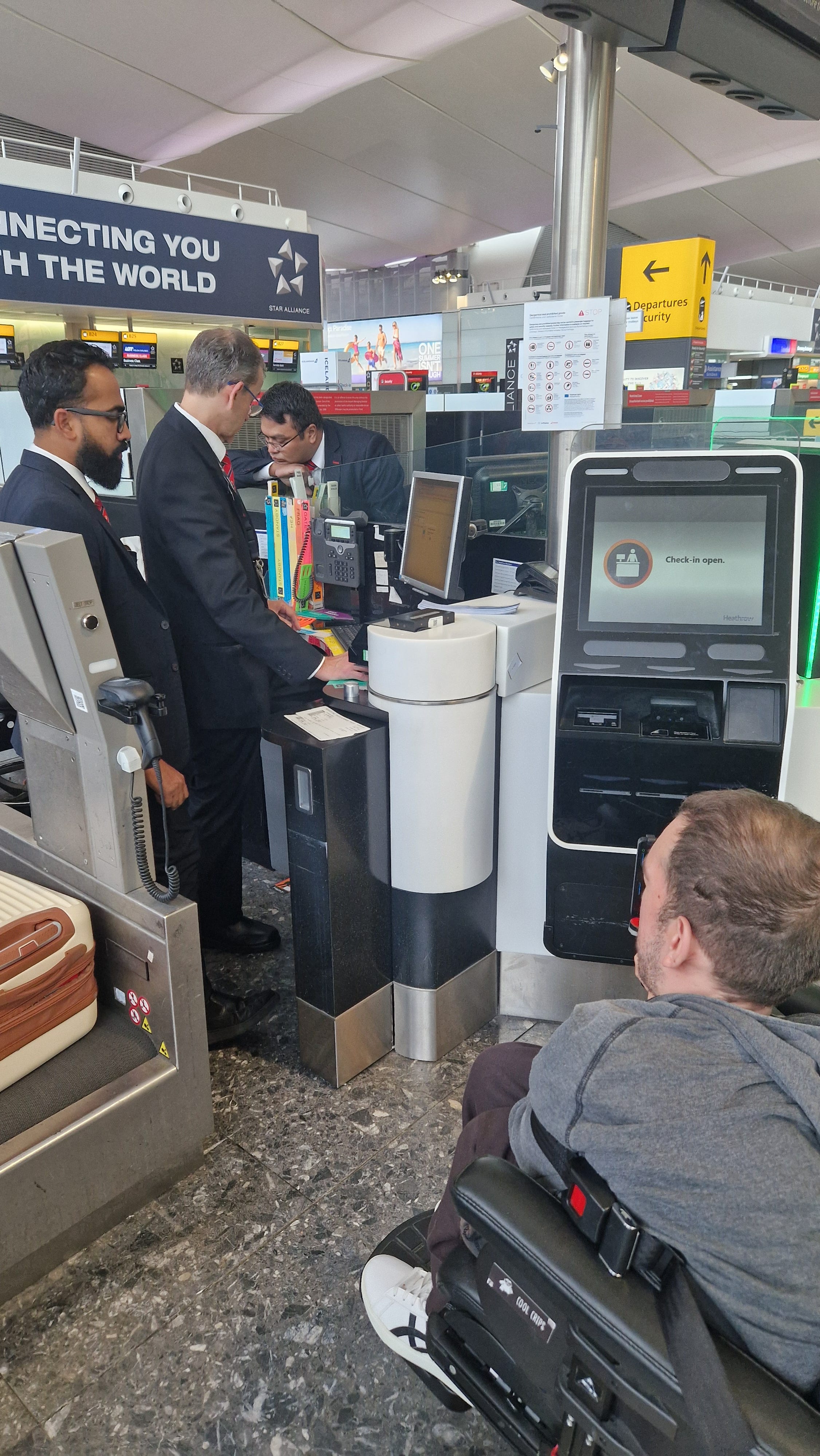
Recently I was travelling to Vienna, a destination I have visited many times for work, and usually its airport experience is among the best. But this time, at the check-in was a newly hired employee who had never dealt with a passenger travelling with an electric wheelchair. For almost an hour she searched in her computer, made phone calls and tried to understand what to do while the queue behind me kept growing (and frustrated). Eventually she started crying because she felt overwhelmed, seriously. I felt a bit sorry for her because the problem was not her willingness to help, but on the other hand she didn’t do her job correctly. Once I was referred to a more experienced colleague, everything was resolved within minutes.
That experience also reminded me that disabled passengers should not have to compensate for inadequate training. Airlines and airports have a responsibility to ensure that the people assisting disabled passengers know the regulations, understand the equipment they are dealing with and have the confidence to apply the rules correctly. Quite simply, people should be able to do the job they were hired to do, without relying on disabled passengers to educate them. I don’t know how many times I have explained that since my wheelchair doesn’t have lithium batteries, the questions they ask (about watt-hours etc) are not relevant.
Then there is the physical risk. Despite all the labels and handling instructions, wheelchairs continue to be damaged during air travel. We are sometimes refused the possibility to remain in our own wheelchair until the aircraft door or to have it returned immediately after landing, even though these measures reduce the risk of damage and of injuries to ourselves. A wheelchair is not just another piece of luggage, it is the extension of our own body.
What frustrates me is not that aviation is complex (even though many times it gets complex for no real reason). Of course it is, and safety should never be compromised. What frustrates me is that the complexity is too often transferred to disabled passengers. We shouldn’t be expected to become experts in aviation or dangerous goods regulations. The system should be built in that way where passengers can travel without having to constantly prove that they are safe.
I left the workshop with mixed feelings. I was glad this topic was discussed on a high level, and I was encouraged by the willingness of many stakeholders to listen, understand each other’s challenges and work towards better solutions. These conversations are essential and they need to continue. But I was also reminded that the burden of accessibility still too often falls on disabled people ourselves. We are expected to adapt to systems that were never designed with us in mind, instead of those systems adapting to us.
We should not have to prove that we are not “moving bombs” every time we fly. We should not be treated as potential security threats simply because we use electric wheelchairs. And we certainly should not have to do other people’s jobs just to have the same freedom of movement that everyone else takes for granted.
Air travel will become truly accessible when informing the airline once (max) is enough, when staff know the rules without passengers having to teach them, and when travelling with a powered wheelchair is treated as routine rather than exceptional. Maybe even by sitting on your own wheelchair while flying.
That is what inclusion should look like.
Till then I will continue fighting and flying.