
Accessible Athens: A Local's Guide
From the airport and public transport to sidewalks and the Acropolis, here's what to expect before your trip

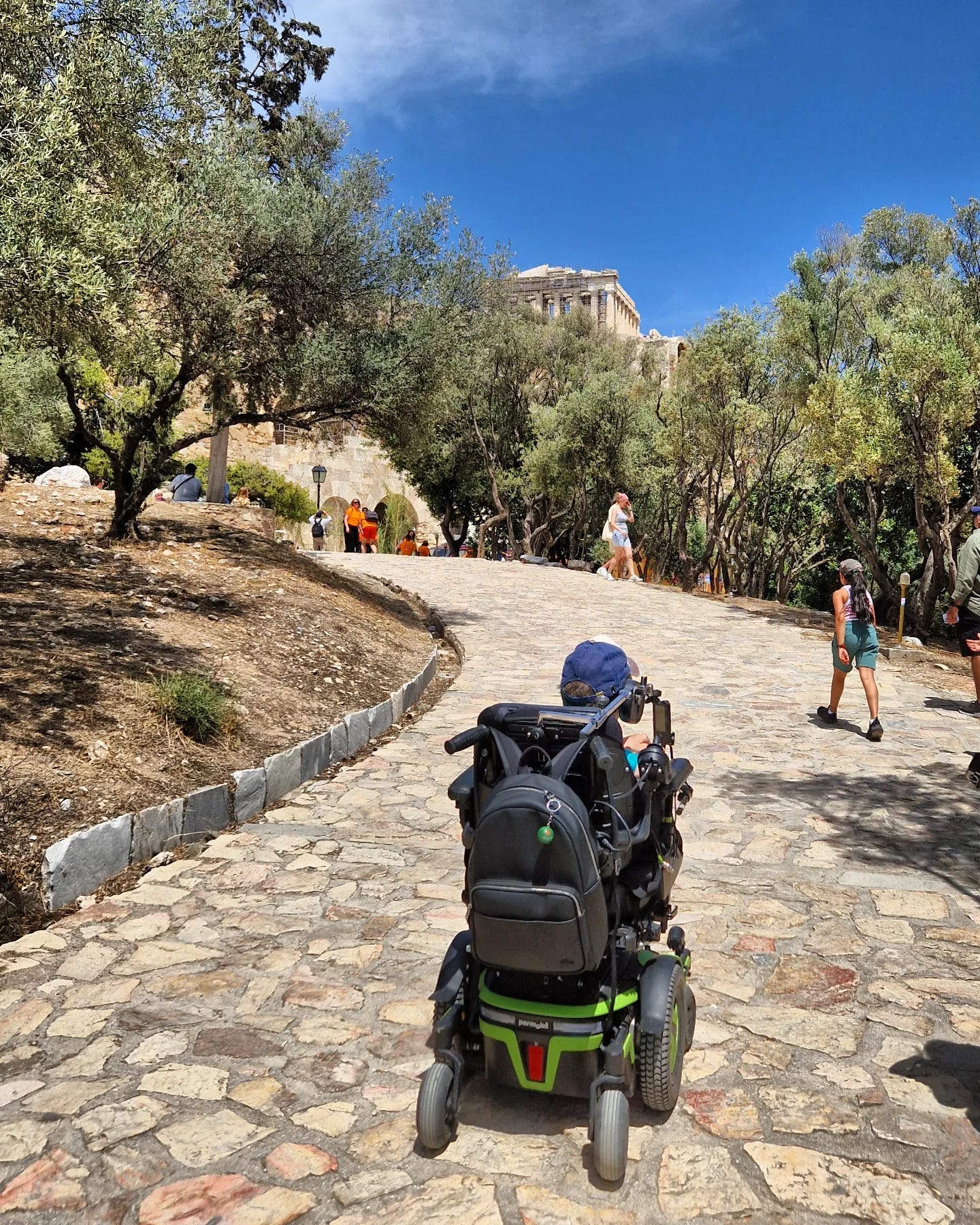
This guide is an updated version of one I originally published on my old website. I’m gradually bringing my travel articles back to life here on Substack, revising them with new information and fresh experiences.
It’s one thing to write about a city you’ve visited for a few days. It’s another to write about the city you call home. As someone who has spent years exploring Athens in an electric wheelchair (but still discovering new parts!), I wanted this guide to be both honest and practical. I’ll try to show you the city through the eyes of both a local and a visitor, so you know what to expect before you arrive.
Athens is the capital of Greece, and its biggest and most populous city by far. Here you can find the famous Acropolis, and many other sightseeing spots. The city also offers access to the sea, even though not of the quality that you can experience when visiting the Greek islands for example. Athens however, can be a quite challenging place to visit, especially if you are disabled, so I wrote this piece to give you a basic idea on how it is.
Getting to Athens
The most common way to arrive in Athens is by air (plane). The city’s international airport, Eleftherios Venizelos, is the largest airport in Greece, and has been in use since 2001. Being quite “new”, and getting expanded during the previous years, its facilities are in a quite good condition, and it is easy to navigate, compared to other airports. The services it offers are of high standards, and the staff that support disabled travellers as well. I travel a lot and definitely here the experience is among the best. Of course, as in most European countries, wheelchair users (especially those with heavy electric wheelchairs) can experience some issues with the loading/unloading of their equipment to the plane, but most of the time I think that the process goes smoothly, especially if they are prepared properly and instruct the staff about everything.
You can also arrive by the sea (with cruise ships etc), however, as I am not very familiar with that option, I will need to do some research before writing here, and in the meantime I will leave it to you to look for more information in case you are interested. Let me just tell you that the port of Piraeus is quite big and can become chaotic, but it’s well connected with the city by metro and buses.
Getting from the Airport to the City
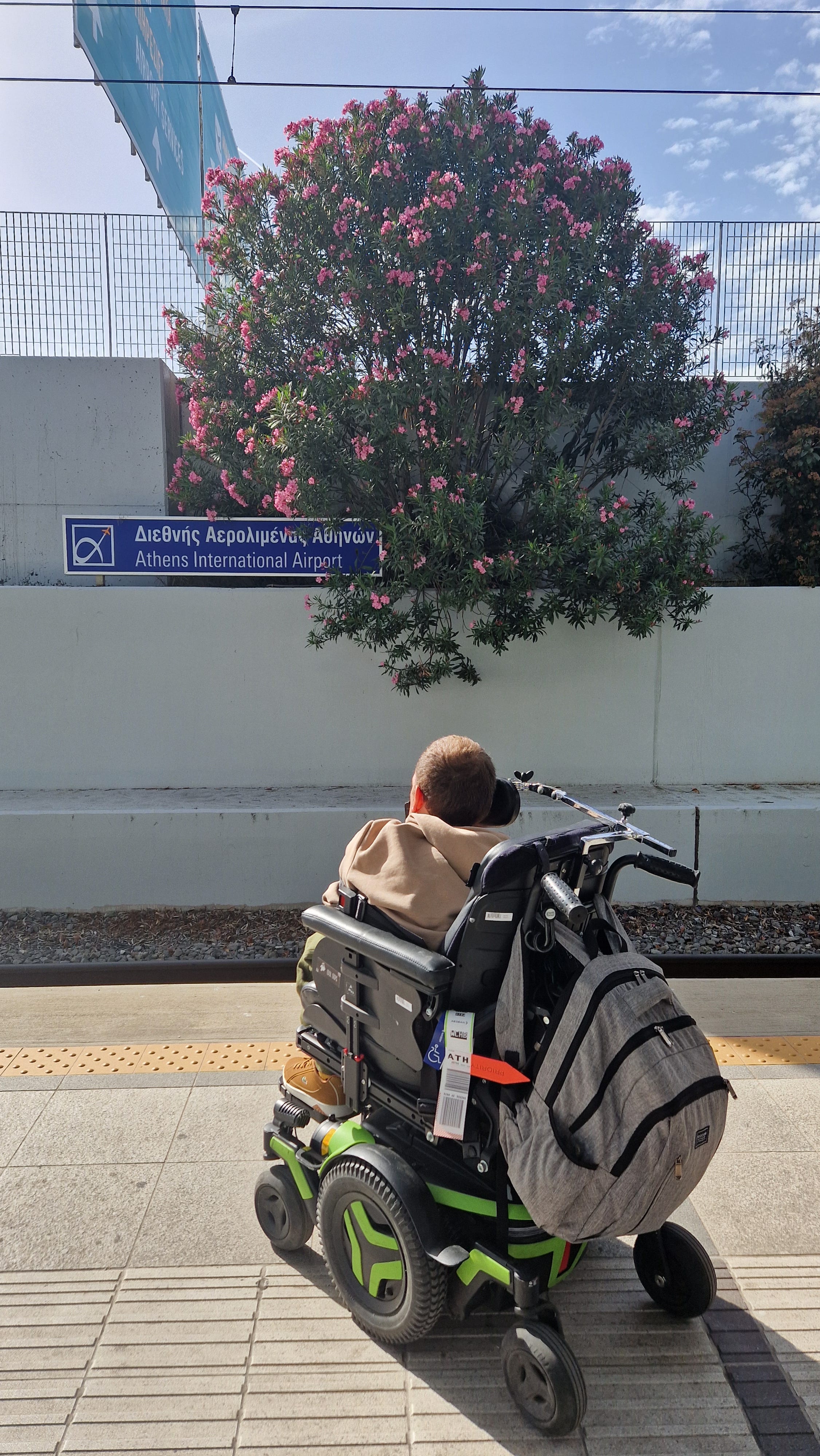
Going back to the airport, once you arrive, four main options are available for your transportation to Athens (the airport is located at Spata just outside the city): You can of course use a private car if you have one, but apart from that, a taxi (adapted or not), the metro-subway and public buses are also available. If you are a wheelchair user, the metro is the best option you have (more on this below). Buses are usually accessible, however sometimes can have electric ramps, which often do not function properly or the driver does not know how to operate them (it happened to me a few times to instruct drivers on how to do it because they didn’t know). More new buses are driving in the city nowadays, so this is less of problem compared to the past. As for adapted taxis, they are extremely expensive and not always willing/available to come. So unless there is an important reason that prohibits me from using the metro (such as bad weather, strikes, late hours etc), I go with it. The only actual disadvantage of the metro is that it doesn’t work in the night, so if you are late in the night there you may need to find another transport solution. Buses are working 24h so they might be an option.
Getting Around Athens
The same transportation options apply to the city as well, with the addition of the tram. Wherever there is a metro station that works for you, regarding your destination, go with that. Even if you are not disabled, I would still recommend using it instead of the other available means. Metro was built for the 2004 Olympics and Paralympics. As such it is quite new, and accessibility was taken into account when it was designed. All the stations are wheelchair accessible and you can board the trains without major difficulties. Moreover, there are voiced announcements about the stops (sometimes they do not work though), and tactile paths for the blind. The only thing you should pay attention to (especially if you are a wheelchair user) is metro’s green line. It is an older subway line that was incorporated into the metro network, which is a bit less accessible. While there are elevators at the stations, the gap between the platform and the “train” itself is often huge. A ramp, which can be placed upon request on the spot, is available however, only in two central stations (Monastiraki and Omonoia), if I am not mistaken. But you can tell the driver or the staff where you are heading to and someone will wait for you and assist you at the station you need to go. Keep also in mind that elevators can often be out of order. The tram, which I mentioned above, is theoretically accessible. However, if you use a wheelchair it is possible that you will find it difficult to enter, as its floor can be at a higher level than the platform. It depends on the station and the tram model you will take.
Sidewalks: Athens' Biggest Accessibility Challenge
Let’s now talk about the city itself.
For starters, it is good to know that if you are a wheelchair user (even more an electric wheelchair user!) you will find it quite difficult to use the sidewalks of Athens. Disabled friends of mine from abroad describe it as the biggest accessibility issue of our city. Lack of ramps is the first reason for that. Or to say it more properly, it is not that there are no ramps. There are sometimes, but they are often not usable. A car can be parked on one, another one can be damaged, and a third one will look more like a step rather than a ramp. And even if you “take the risk” to use a ramp, the sidewalk can be too narrow for you to pass, trees can be planted in its center, you can find trash or cafeteria tables on it, or you will come to realize that there is no ramp on the sidewalk’s other corner for you to cross the road, so you will have to go all the way back. Those are just some examples of what you can experience on an Athenian sidewalk. In the city’s center some sidewalks can be indeed used. And there are sometimes such cases throughout the city. However, even in those, expect potential difficulties. You will ask me now how I manage in this city. Well, I usually just roll on the streets (this is a video from my university years)!
Accessibility of Buildings and Attractions
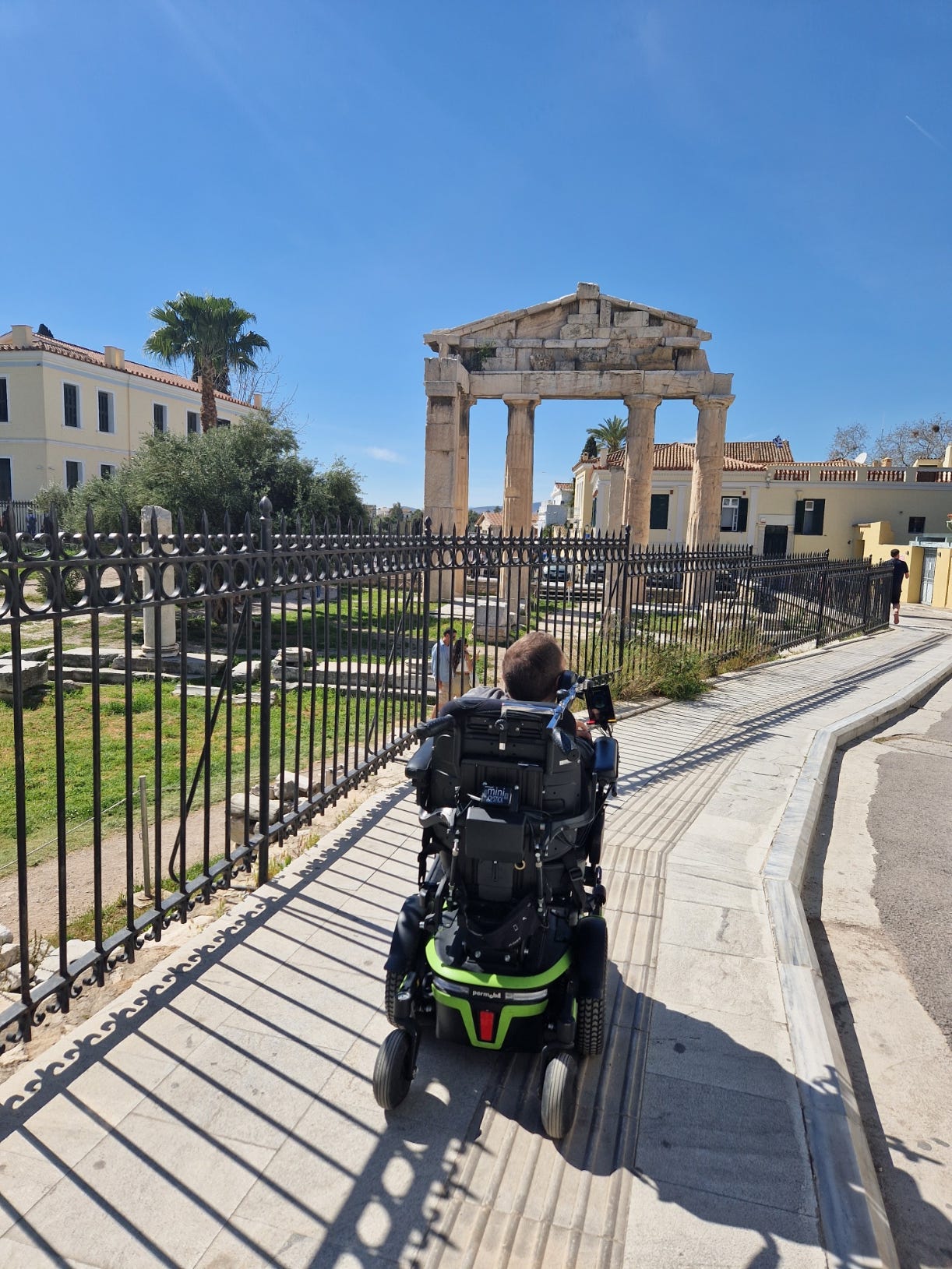
As for the accessibility of the buildings, some are accessible, some partly, and many are not. As in many other European countries I guess. Many museums are accessible, and offer discounts for disabled guests. Many restaurants and cafes are also accessible. However, accessible toilets are another issue, so keep that in mind. Even if they exist, they can be locked or used for storage purposes, or even for smoking. Shops may be challenging too. By taking a stroll for example on Athens’ major shopping street, Ermou, you will notice that many shops have steps. We also have a few shopping malls, and these are accessible and generally wheelchair friendly.
The most important sightseeing spot of Athens, Acropolis, is wheelchair accessible. You can have a look at my video with CareUnderSun (I fully recommend them if you need help with planning your trip) where we visit the Acropolis hill, and the Parthenon. In the area below the hill (and in a few others) there might also be some cobblestones, but in general this is not much of a problem in our city.
More on the sightseeing spots of Athens, museums, areas for stroll, food etc will follow in the part 2, that will be published soon, so stay tuned!
Final Thoughts
Having said all that, you should not be discouraged to visit Athens! Despite the fact that the city has a long way to go to be considered an accessible city, it has seen many improvements during the last two decades, and it is totally possible to visit and enjoy it with a wheelchair. If you are prepared and know what to expect, you can have a great time in this lively city. And if you need any additional information, don’t hesitate to get in touch with me here, on Instagram, on Facebook or on X.